
Taking Care of Your Mental Health While Working Remotely.
Remote work has opened doors to flexibility and freedom – but it has also quietly introduced new challenges to our mental health.
From blurred boundaries to constant screen time and isolation, many people are struggling in ways they don’t always recognize.
In this conversation, we explore what’s really happening beneath the surface – and how to create a healthier, more balanced way of working remotely.
Let’s hear some mental health tips for remote work, from a professional.
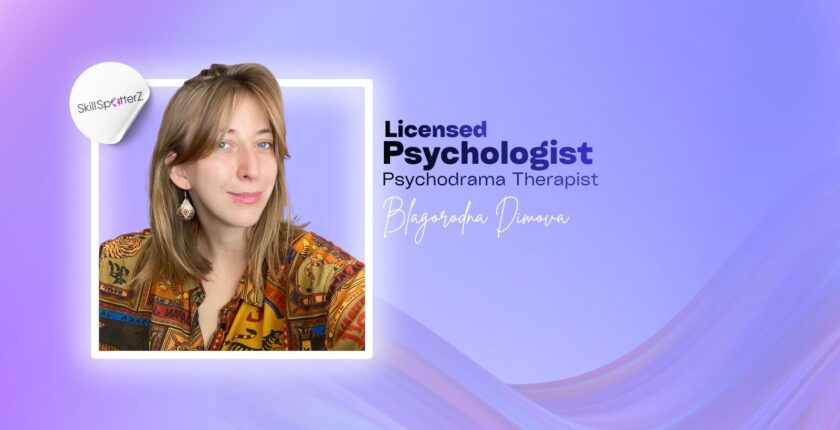
Meet Blagorodna Dimova,

Blagorodna is a licensed psychologist specializing in Psychodrama.
What makes her approach unique is how closely her professional work reflects who she is as a person – grounded in authenticity, presence, and compassion.
She believes therapy isn’t just a method, but an extension of how we connect, understand, and show up for ourselves and others.
For her, the most meaningful achievement isn’t something external – it’s the trust her clients place in her every day.
The reason why we invited her for an Interview is that…
Your Mental Health matters more than you think… So, let’s dive into this interview and see why that is.
💬 Why does remote work create unique mental health challenges compared to traditional office work?
Remote work creates unique mental health challenges primarily because it blurs the boundaries between professional and personal life.
Without physical separation from the workplace, employees often struggle to disconnect, leading to longer working hours and an “always-on” mindset.
Many remote workers check emails outside regular hours, including weekends and even vacations, which increases the risk of mental exhaustion over time.
Additionally, remote work can reduce social interaction.
The lack of in-person contact with colleagues may lead to feelings of isolation and loneliness, which are linked to higher stress levels and lower motivation compared to traditional office environments.
💬 How can someone know what their own version of healthy balance looks like- and, most importantly, how can they identify and address what’s affecting them negatively?
Healthy balance is quite individualised, in my opinion.
Self-awareness, or seeing how your body and emotions react to your everyday experiences, is the first step.
You may be experiencing an imbalance if you frequently feel worn out, agitated, nervous, or disengaged.
I frequently advise my clients to pose these three easy questions to themselves:
- When do I feel most secure and invigorated?
- When do I feel tense or exhausted?
- What circumstances cause stress or discomfort on a regular basis?
💬 Many remote workers struggle to get into “work mode” and feel stuck despite having many tasks. What causes this kind of work paralysis- and how can someone overcome it?
As a psychologist, I frequently observe that this type of “work paralysis” is typically a stress reaction.
The brain may feel overburdened by too many tasks, hazy priorities, or internal pressure to perform if boundaries are not well defined.
This causes anxiety, which can cause the nervous system to freeze instead than react. Even though there is a lot to do, the outcome is feeling trapped.
Other factors include emotional loneliness, mental exhaustion, fear of failing, and perfectionism. Avoidance turns into a temporary coping mechanism when duties seem too large or emotionally taxing.
Additionally, it is crucial not to fight alone. Consult a trusted individual, such as a close friend or relative.
Sharing lessens the emotional burden.
Additionally, consulting a psychologist is a responsible and healthy course of action if the paralysis persists or feels overpowering.
Seeking assistance is a form of self-care, not a sign of weakness.

💬 Procrastination is common when working from home. Why do people delay tasks until deadlines, and how can they break that cycle?
While procrastination may look like an issue with discipline to many people, I see it as a problem with emotional regulation.
If you are faced with an emotionally challenging task – one that causes anxiety, boredom or fear of failure – your brain will automatically search for things to do as a way of “repairing your mood”; your instinct is to find something else to do, such as checking social media or cleaning the house.
The fact that you’re working from home makes this even more difficult, since the physical and social boundaries that normally tell you “now is a time to be professional” are not present.
To break this avoidance cycle, it’s important to move from being self-critical to being self-compassionate.
Shaming yourself will only serve to increase the stress that led you to avoid the task initially.
To reduce the threat response that the brain has to beginning a task, commit to doing a task for five minutes.
This will reduce the threat response in the brain and facilitate the beginning of the task.
Another tip for breaking your cycle of procrastination is to create psychological anchors (because you no longer have your physical commute to and from work).
You can provide a different experience to your brain by developing rituals that use your senses (e.g. changing your clothes, using a specific desk, using a particular scent) so that you are “primed” to work.
When the day is done, “hide” your work items so that your nervous system knows it is safe to transition from performing to resting.
💬 How can someone prevent burnout when their entire workday happens online and at home?
The main issue of losing containment of your mind contributes to burnout when you’re working from home.
Because a physical separation does not happen through an office anymore, you lose the environmental signs that give your brain a cue that a “threat” (i.e. work) is no longer a threat; therefore, your nervous system always appears to be on guard.
This results in Role Blurring as the two Bearers of Your Self (Professional and Private) are unable to separate; therefore, the parasympathetic nervous system is unable to restore the mind and body through deep restoration.
To stop this, you must create a closure to the Stress Response Cycle.
After you have closed your laptop, the physiological stress of the day often resides in your body.
Typically, when you have commuted home, the physical act of travelling home gives your brain a liminal space to de-stress at once.
Instead, you must establish a way for your brain to recognize the end of performance and the beginning of recovery (a sort of “psychological commute”) by performing a ritualistic act for about 10 minutes that is sensory-based (such as changing your clothes or doing a set amount of breathing) and signifies to your amygdala that it is time to move from performance mode to recovery mode.
💬 What are the early signs of stress, anxiety, or emotional overwhelm that remote workers should pay attention to?
Signs of stress in remote workers are frequently internal signals that indicate the nervous system is on the verge of losing its window of tolerance.
The absence of externally observable feedback from coworkers means these subtle changes may go unnoticed by you until the situation escalates to a crisis level.
In a majority of cases, the first sign will be Somatic Tension.
The body processes stress before the brain does, so you may notice shifts in your body language in terms of high levels of tension in your muscles, such as a clenched jaw, quick and unsteady chest breathing patterns, and recurrent pain in your neck and/or shoulders.
Having difficulty sleeping, such as feeling “tired but wired” at the end of the work day indicates that your cortisol levels are not lowering during the night as they should be.
From a cognitive perspective, experiencing overwhelm can manifest as Executive Dysfunction.
For example, completing tasks that take ten minutes without needing extra effort can now require an hour, or you can experience “brain fog” and forgetfulness.
In the context of Executive Dysfunction, procrastination represents a way to avoid doing a task that your brain feels is going to be emotionally overwhelming.
From an affective standpoint, there is a need to keep an eye out for Irritable Behaviors; when you become angry or irritated due to technical glitches during the day or when you feel “flat” or apathetic, your ability to manage your emotions may be depleted.
💬 How does constant screen exposure and digital stimulation affect mental health, and how can people manage digital fatigue?
Being continually exposed to screens and receiving digital stimulation causes our nervous systems to be wired into an ongoing state of partial-attention, allowing us to not settle into a state of deep relaxation as our pre-frontal cortex is overstimulated.
Thus, we develop Directed Attention Fatigue, (the brain’s ability to control and moderate our emotions and focus lessen biologically) leading to manifestations of irritability or ‘brain fog,’ for example.
From a Psychological point of view we do not receive enough Non-Verbal Social Cues with the Use of Digital Communication, so our Brains are forced to work extra hard to compensate for this lack of input. Consequently, our Cognitive Load is significantly increased.
To deal with this overload of information you will need to create a means of Digital Containment.
One way to do this is to schedule White Space throughout the day where you can allow your Default Mode Network (brain’s method of learning) to kick-in and allow your brain to process new information.
In addition, to help ground/relink the nervous system and to complete the stress response cycle left open by screens; it is necessary to participate in Tactile/Multisensory activities outside of the Digital Realm.
💬 How important is social connection for mental well-being, and how can remote workers prevent isolation?
Having social connections is a physical need, not just a nice thing to have.
Our nervous systems are interconnected with each other and rely on the safety of others to help regulate our nervous systems.
Remote workers are experiencing social starvation and therefore are lacking in oxytocin and activation of their mirror neurons to help contribute to their emotional resilience.
To shift on a psychological level from the psychological flatness of isolation, you need to move from a passive mode of connecting to an intentional mode of connecting by prioritizing voice or video connections that are focused on sharing personal experiences instead of completing work tasks in a transactional manner.
Creating a third space away from your home (library, cafe or park) is the best way to revive your variety of sensory experiences and peripheral social connections that reinforce your feelings of connection to others in society.
And by connecting with others, you are developing the connections needed to allow your nervous system to maintain its window of tolerance and help prevent the development of depressive withdrawal.
💬 What are healthy ways to create boundaries between work and personal life when both happen in the same space- especially when living with family or partners?
To keep your work-from-home balance in order, create an area that you only work in so your mind can separate the act of working from relaxing.
As we discussed before regarding the importance of creating physical boundaries in your head, create a closing “shutdown” ritual (such as taking a short walk) that will allow you to transition to being not an employee to being an employee, as well as to provide a closure signal for your workday.
Making a “symbolic commute” by leaving your home immediately after completing your work will help to avoid professional stress bleeding into your personal life by creating that transition.
Clearer communication of your schedule to those you live with provides them with a means to know when you are available, as will your use of other physical indicators (closed doors and/or wearing headphones) that you are unavailable for communication.
At the end of your workday, when you are finished, you should spend time giving your family completely undivided and device-free attention in order to create a quality connection with them instead of just being present physically; finally, exhibit self-compassion by focusing on being consistent over the long haul rather than worrying about having every day perfectly structured.


💬 How can someone recognize unhealthy perfectionism or overworking tendencies and set limits without feeling irresponsible?
Recognizing excessive perfectionism and workaholic tendencies is to determine that your behaviors are fear-based, resulting in black-and-white decision making and a struggle with separation from the work you do.
For example, if you tie your self-worth to your level of productivity, have feelings of guilt about taking a break, and are experiencing physical health issues, you are likely working too much.
When setting boundaries, consider reframing your boundaries as professional tools that promote sustainability rather than neglect. Use the “start small, communicate needs objectively, and prioritize outcome over total output” approach to establish boundaries.
💬 You practice walk-and-talk therapy. Why is movement so powerful for mental clarity, and how can remote workers apply this in their daily routine?
By reducing stress hormones, activating the release of “feel-good” neurotransmitters (such as endorphins, serotonin and dopamine), and promoting bilateral stimulation of the brain which can help with processing complex emotions; movement can clear the mind.
As a remote worker, implement movement into your daily workday through “walking meetings,” short (10-minute) “movement snacks” in between meetings/tasks or by creating a psychological boundary between your working and non-working time by taking a walk in the morning/afternoon before, during or after your workday.
💬 How can someone set healthy boundaries with family members while working from home without creating tension?
To set healthy boundaries without creating tension, you must first deeply understand your partner and maintain radical honesty about your collective needs.
Working from home acts like a magnifying glass; it often exposes unresolved household imbalances or “unfinished business” that was previously hidden by an office routine.
Creating a successful environment requires a collaborative effort from both sides to build a solid relationship foundation, rather than just sticking to a rigid schedule.
By addressing these underlying issues during non-work hours, you prevent professional stress from migrating into your family life.
When you frame your boundaries as a way to eventually be “100% present” for your loved ones, they feel like a priority rather than an interruption.
Finally, as we discussed, using that physical transition away from the house allows you to shed the “employee” persona, so you can return to your home life with genuine patience and a clear mind.
💬 Does a truly balanced and mentally healthy remote career exist- and what would it realistically look like?
A truly balanced and mentally healthy remote career can exist, but it looks different for everyone.
At its core, balance means being able to complete your work responsibilities effectively while still functioning well and feeling present in your personal life afterward.
If your sleep is consistent and restorative, if you can clearly separate working time from personal time, and if you’re not carrying work stress into moments meant for your partner, child, or family, that’s a strong indicator of a well-balanced life.
Ultimately, a healthy remote career is not about perfect structure, but about maintaining boundaries that allow both productivity and genuine rest.

💜 Blagorodna, what’s one lesson, mindset, or mantra you keep coming back to?
A principle I return to often is this: no one else on this planet, regardless of what they say or do, has the power to take away your sense of self-worth.
That is something you hold. And when you are grounded in your own value, you begin to protect it – through the way you treat yourself, the choices you make, and how you choose to spend your time.
If you feel like you need to talk to someone, say things out loud, help yourself in any way you can – YOU are not wrong and the best way is to turn to a professional who has been trained and developed techniques that can help you out.
We are leaving Blagorodna’s contact details here, so you can reach out anytime you might feel the need.
