
How to Turn Your Skills Into a Profitable Business – After Leaving Corporate.
What does it really take to go from corporate job experience to running a profitable business?
Let’s hear from someone who has done it, lived through it and coached others how to do it.
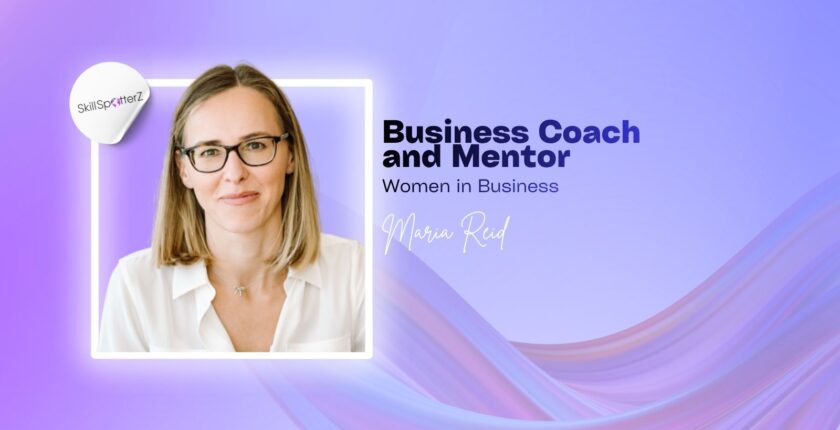
Meet Maria Reid,

Founder of Women in Business Coaching Ltd, where she works with experienced women around the world who want to turn their skills and career experience into profitable, sustainable businesses.
She focuses on business strategy and money mindset, working with women who already have strong careers but are trying to figure out how to turn that into something real – clear offers, confident pricing, and steady income.
A big part of her work is helping them make sense of what they already know, shape it into services people actually want, and attract better clients—without falling into the trap of undercharging or overworking themselves.
Maria is also involved in research on female entrepreneurship with Essex Business School and Anglia Ruskin University. This gives her a clear view of what’s really happening for women making the shift from corporate into business – what’s working, what’s not, and where most people get stuck.
★ In this interview, she shares practical insights on how to make that transition, how to figure out what services to offer, and how to build a business that actually fits your life – not just your career history.
🎙 Why are so many women choosing to leave corporate and go into business or freelancing?
There are definitely broader economic and social drivers behind this shift, but what I find most interesting is that the desire itself is not new.
What has changed is that it has become more achievable.
We have seen:
- Technology makes it easier to work from anywhere
- Remote working has become normal since Covid
- Social media gives access to real stories of women who have made this transition work
All of these have lowered the barriers significantly.
Women can now see that this is possible in a way they couldn’t before.
At the same time, many women are realising that traditional 9-to-5 structures do not fit the realities of their lives.
They have been trying to fit themselves into a system for years that was never really designed for them.
There is also a sense of outgrowing corporate environments.
Progression or sideways moves can start to feel like more of the same rather than real growth or challenge.
So it is not just about trends.
It is about wanting flexibility, autonomy and a way of working that matches both their ambition and their life.
🎙 What’s the first step to shift from an employee mindset to a business owner mindset?
It starts with identity.
Many women come into entrepreneurship with the mindset of “I am new to this” and, without realising it, they minimise their expertise.
They may be new to running a business, but they are not new to the work.
So the first step is developing a clear vision and starting to step into the business owner they want to become.
In practice, that means:
- recognising what you already know
- owning the results you have already created
- separating “new to business” from “new to value”
Confidence does not come first. It builds as you start making decisions from that place of ownership.
Ownership starts with deciding what problem you are best placed to solve, based on everything you’ve already done.
Not everything you can do, but what you consistently do well and where you create real outcomes for people.
That clarity becomes the foundation. Without it, it’s very easy to stay busy but never build something that actually grows.
🎙Many women know they have skills, but struggle to turn them into services people will pay for. How do you help with that?
This is such a common challenge, and it reflects a real shift in how women approach entrepreneurship.
They often don’t come from a “I see a market gap” starting point.
They come from “I have all this experience and knowledge, so what do I do with it?”
And that’s actually a really rich starting point, it just needs the right framework to unlock it.
The key insight is this: businesses work because they solve a problem people are willing to invest in.
It’s no longer about your hours or even your skills in isolation. It’s about the problem you can solve with those skills.
The process I take clients through is quite practical, starting with positioning, through to the packaging, pricing, and sales.
1. We look for trends and patterns in the work you have already done
What kinds of projects, results, and strengths show up again and again?
2. We identify where your work creates the most value
This means looking at the types of clients, organisations, or situations where your experience has the highest commercial value and strongest impact.
3. We define the problem your work helps solve
This is where your experience starts to turn into positioning. Instead of listing everything you can do, we get clear on the specific problem you help people overcome.
4. We map out your process
We turn your way of working into a clear step-by-step solution.
This helps people see that they are not just hiring a person with skills, but investing in a structured way of getting a result.
5. We package that into an offer
This is where the work becomes a more complete solution, which increases the value in the eyes of the client.
It also allows the work to go deeper, become more transformational for the client, and more fulfilling for you because you are fully using your expertise.
6. We price based on value, not time
A lot of women undercharge because they are not yet fully clear on the value of what they do.
Once they can clearly connect their work to outcomes, it becomes much easier to price with confidence.
Charging by the hour may be a starting point for some freelancers, but time does not scale. Value-based pricing is what creates real profitability.
7. We leverage existing networks, relationships, or past clients
Very often, the first clients or first premium clients are closer than women think.
There may already be people in their network who know their work, trust their expertise, and are well placed to buy, refer, or upgrade into a more premium offer.
So part of this process is not just creating the offer, but also using existing relationships strategically to get early traction.
8. We build out a long-term marketing plan
New entrepreneurs need to develop both quick, proactive outreach and conversation skills as well as know how to build visibility, authority and trust over time through content, network and branding.
We build those skills in the programme as well as create a structure they can stay consistent with to create a steady flow of clients rather than short bursts of activity.

🎙Corporate teaches structure and rules, but what does building a business actually require instead?
Many women come from corporate environments where complexity is the norm.
The instinct is to replicate that in their own business, multiple offers, multiple channels, elaborate systems. But that’s often what leads to burnout and stalled momentum.
So I simplify things.
I use what I call the rule of one:
- One ideal client
- one core offer
- one main marketing channel
This creates focus and makes the business manageable.
The second piece is structure.
I help clients build a repeatable weekly rhythm that includes:
- business development
- visibility
- and delivery
Without this, it is very easy to either overwork or avoid the activities that actually grow the business.
Building boundaries and accountability early sets you up for longevity.
Business is a marathon, a long game. Structure is what makes it sustainable.
🎙Pricing is one of the biggest fears for new freelancers and service-based entrepreneurs. What’s your advice?
I really empathise with this because pricing can feel uncomfortable.
But it is, without question, the single most important element of a service-based business.
Get it wrong, and you will work twice as hard, take on the wrong clients just to make ends meet, and end up resenting the business you worked so hard to build.
I think of pricing as both an art and a science.
The science is getting clear on the value your work creates.
If you can’t articulate the outcome a client experiences from working with you, you will always wobble.
You’ll undercharge or back down when someone questions your fee. So the first piece of work is building that clarity.
The art is an ownership piece.
There’s often a real mismatch between what women want to charge and what they actually believe they’re worth.
That’s a mindset conversation, not a numbers conversation.
The right pricing strategy means nothing if you don’t feel comfortable standing behind it.

Many women struggle with imposter syndrome when starting out. How did you recognize and deal with it personally?
I actually think a certain level of imposter syndrome is healthy.
It tends to show up right at the edge of your comfort zone or the edge of your competence – but it is an internal perception.
When you’re charging more, being more visible, or stepping into a bigger version of what you do, you do not yet have full experience or certainty in this new context and that is what creates this sort of response.
For me, it would trigger perfectionism, comparison, a feeling not good enough and real procrastination.
Once I understood it, I was able to acknowledge it rather than trying to fight it, and move forward anyway – imperfectly with a lot of self-compassion.
What helps is grounding yourself in your own experience.
What you know. What you have done. The results you have created.
Also recognising that you do not need to know everything.
Staying in your lane of expertise and being honest about what you do and do not do builds trust.
🎙How do you go from taking any client to attracting the right ones?
Clarity and positioning are a big part of the answer, but underneath that, it is really about how you see your own work.
When you are clear on who you work with, what you do, and what you do not do, it becomes much easier for the right people to say yes.
When you are unclear, you attract a mix of clients, and that often means lower-value, less aligned, more transactional work.
There are a few layers to this.
Clarity on your positioning and the problem you solve
So people immediately understand what you do and where you create value.
Clarity on who you can create the most value for
And recognising that clients perceive value through their context, not yours. The same work can be seen very differently depending on who you are speaking to.
Clarity on how you want to work
If you are building a boutique practice serving a small number of clients deeply, your branding, communication and offers need to reflect that. Otherwise, you will attract volume instead of depth.
Clarity on pricing
Your pricing sends a signal. It communicates the level you operate at and the type of client you are looking to work with.
But beyond all of that, there is a deeper piece.
We tend to attract lower-level or less aligned clients when we doubt ourselves, when we diminish our own skills, or when imposter syndrome takes over.
In those moments, it is very easy to lower standards, over-explain, or accept work that is not quite right.
Attracting high-value clients requires a level of self-trust and leadership.
It means:
- standing by the results you know you can deliver
- communicating with clarity and conviction
- being willing to say no to what is not aligned
High-value clients are not looking to be convinced.
They are looking for someone who understands their problem, can guide them, and can deliver a result.
Clarity makes that visible and self-trust is what allows you to hold it.
🎙How can women avoid burnout and build a more balanced way of working?
One of the biggest traps for women stepping into freelancing or entrepreneurship is recreating corporate pressure inside their own business.
Taking on too many clients, underpricing, and overdelivering.
It is incredibly common, and it usually comes from not having a clear definition of what you actually want your business to look like.
Early on, I encourage clients to get clear on a few key things:
- how many clients they want to work with
- what each client needs to be worth financially
- what kind of work they actually enjoy
- what income they are aiming for
Then we design the business around that, rather than taking everything that comes.
Packaging your services properly is a big part of this.
It stops delivery from consuming all of your time and attention.
It helps you set boundaries, avoid scope creep, and removes the need to rebuild every proposal from scratch.
Pricing also plays a key role.
If you are working hard but still not hitting your income goals, it is rarely because you need more clients.
More often, it is because your pricing is not aligned with the value you provide.
And finally, structure matters.
Focusing on the few activities that actually move the business forward, rather than trying to do everything, is what makes the workload sustainable.
Burnout is rarely just a time or workload problem.
More often, it is a pricing and mindset problem.
When your work is underpriced or poorly structured, you need more of it to make it work.
That is what creates pressure.
🎙 Why does mindset- especially around money and self-worth, matter so much when building a business?
Because every decision and action we take flows from our mindset – the thoughts, beliefs, and feelings that have been shaped by a lifetime of experiences, conditioning, and subconscious imprinting – about money, around ourselves, around what’s possible.
This conditioning doesn’t automatically update when we change context, and for women stepping into entrepreneurship, the mismatch can be stark.
You can feel like you’re taking one step forward and two steps back, not because the strategy is wrong, but because an older belief system is running the show underneath.
The good news is that mindset isn’t fixed.
What we’ve learned to think and feel about money, about our own worth, about the world – can change.
But it requires awareness, and it requires someone holding up a mirror and also holding a stronger possibility for you.
A lot of our identity is tied up in what we do and the role we play.
In entrepreneurship, learning to separate your self-worth from business outcomes, while also expanding what you believe is possible for you, is some of the most important work there is so that you are not holding yourself back or sabotaging your own success.
Developing self-awareness helps you see where old patterns or beliefs are getting in the way.
🎙 Why is financial independence such an important mission for you—and what changes for women when they build their own business?
Because, women are disproportionately exposed to financial vulnerability, through caregiving responsibilities, career interruptions, the gender pay gap, and structural barriers that still very much exist.
I felt that acutely when I became a mum and had to navigate the tension between ambition and being present.
Entrepreneurship is a genuine vehicle for financial independence.
There’s no cap on what you can earn.
No organisational politics deciding your progression.
No structure that wasn’t designed for your life is trying to contain you.
What I see when women fully step into their expertise is that they don’t just build businesses.
They build lives that feel more aligned, more flexible, and more financially secure.
And they do it without having to sacrifice who they are in the process.
That matters to me deeply.
And I think the ripple effects go far beyond the individual.
Women are building businesses that are more people-centred and more purpose-driven.
That reshapes how we think about work and success more broadly.
There’s still so much untapped potential, and so many women who are far more capable than they currently give themselves credit for.
🎙 What results do women typically get from your program, and how do you guide them through the process?
The results are both practical and personal, but they are always grounded in real business change.
From a business perspective, clients typically leave with:
A clearly defined niche and positioning
They know exactly who they serve and what they are known for. This makes it much easier to go after the right clients and have the right conversations.
What I often see before this is women speaking to misaligned clients and trying to prove themselves to the wrong audience.
That leads to repeated rejection, which can wear down confidence and make it feel like something is not working. In reality, it is often just a lack of alignment.
Their expertise structured into a clear process or methodology
A lot of experts struggle with marketing because their expertise lives in their head.
Once it is mapped out into a clear structure, it becomes much easier for both them and their clients to understand the value of what they do.
A defined offer with a clear scope
This makes proposals and pricing much simpler.
When you are clear on what you offer and how you deliver it, it brings a level of professionalism and confidence into the way you show up.
Pricing that reflects the value of their work
This often leads to significant increases in fees. Once you see the value you create clearly, you cannot unsee it.
More consistent, higher-quality clients
Clients who are a better fit, stay longer, and are easier to work with.
When there is clarity and conviction in the business, it changes how clients experience working with you.
Conversations become easier, clients are more engaged, and the work feels more aligned.
In terms of outcomes, I have seen clients:
- increase their pricing by 50 to 70 percent
- double their client base
- go from 5 and low 6 figures of revenue into multiple 6 figures
- one client doubled her business within four months after clarifying her positioning and offer.
- one client has tripled her revenue after doubling her prices and increasing her sales conversion
- move from one-off or smaller projects into longer-term, higher-value engagements
- generate repeat work more easily because their offer and positioning are clearer
- have clients say yes more quickly because the value is understood upfront
- feel more confident in conversations, without overexplaining or justifying their value
- walk away with a scalable business model
But beyond the visible business results, there is a deeper shift.
Clients move from feeling unclear and overwhelmed to confident and unstoppable.
They start making decisions with clarity, confidence and a stronger sense of ownership and leadership.
They stop trying to fit into what they think a business should look like, and start building one that reflects their level of expertise, aligns with their values, and supports the life they want to create.
That combination of strategic clarity and internal shift is what makes the results sustainable.
🎙 What would you advise any woman who is now thinking of transitioning to leave the corporate world?
Don’t rush into building something without a clear starting point.
You don’t need to have everything figured out, but you do need to know what problem you’re solving, for whom, and why you’re the right person to solve it.
Focus on what you’re genuinely good at.
What people already come to you for. Where you create real outcomes.
Build from there.
You don’t need to reinvent yourself.
You need to recognise and structure what’s already there.
♥ Maria, what’s one lesson, mindset, or mantra you keep coming back to?
When you look inward, you often see doubt or question if you’ve got what it takes.
When you look outward, you see your accomplishments, the value, and the impact you have created.
Anchor yourself in that reality, not the noise in your head.
That is how you build strength, self-trust, and leadership from the inside out.
